Growth Pages —
one system, many pages, every funnel stage

Most of my web work doesn't fit a single case study — it's a body of growth and marketing pages produced at volume. Rather than design each from scratch, I built one visual system and a set of reusable patterns, then dialled the conversion intensity up or down to match where each page sits in the funnel. This gallery groups that work into four families: student-success proof, product and program pages, sessions and events, and careers.

The opportunity

Growth runs on page volume

A growth team ships constantly — a launch page this week, a success report next, a session registration, a careers post, a partner event. No single one of these is a flagship case study, but together they are the bulk of the public-facing web work, and they all have to feel like one brand while being produced far too fast to hand-craft individually.

Problem statement

Why volume breaks consistency

Produce dozens of pages with no system and three things go wrong:

  1. Every page drifts visually until the brand looks fragmented
  2. Each page is slow to build because nothing is reused
  3. Pages forget which funnel stage they're for — selling when they should reassure, or vice versa

The answer wasn't one beautiful page. It was a system — shared patterns and a visual language — that any of these pages could be poured into, then tuned to the specific job it had to do.


One visual system, many pages

A shared language — the same headers, footers, stat panels, icon-led explainer blocks, and proof patterns — so a launch page and a careers page read as the same brand even though no two are identical.

Match the page to its funnel job

Conversion intensity scales with intent: a free top-of-funnel page reassures and educates; a high-ticket program page leans on scarcity and proof; a post-registration page switches from selling to retaining. Same system, different dial settings.

Design for production, not one-offs

Patterns reusable enough that the next page is fast to build and on-brand by default — using a page builder for speed, and dropping to custom CSS and JavaScript only where the interaction demanded it.

Growth design is a systems problem disguised as a page problem. I built the system once, then spent my time on the decision that actually varies per page: what job is this page doing, and how hard should it push?

I designed and built these pages on a page builder for production speed, extending them with custom CSS and JavaScript wherever the native components couldn't deliver the interaction — filters, carousels, countdowns, and the like. The gallery below groups the work by the job each page does; every card opens the live page.

Four families of page, each tuned to a different moment in a prospect's journey — from proving the product works, to selling specific programs, to running live sessions, to hiring the team behind it all.

3.2Product & program pages — complexity made scannable

Each product page takes something genuinely complex — a 1-on-1 mentorship program, a question-adaptive mock engine, a three-stage learning method — and breaks it into icon-led blocks, big-number stat panels, and head-to-head comparisons. The conversion dial moves with the price: a free mock says "try it"; a $499 program leans on scarcity and alumni proof.

3.3Sessions & events — one template, every state

The live-session pages run on a single registration layout — hero, countdown, details card, expandable content modules, host bios — content-swapped per topic. The sharpest decision is the post-registration state: the same template repurposed from acquisition to retention, swapping the register CTA for add-to-calendar and a guided pre-session checklist. Partner events (like the CAT decision-makers session) reuse the same system co-branded.

3.4Careers — selling the company to candidates

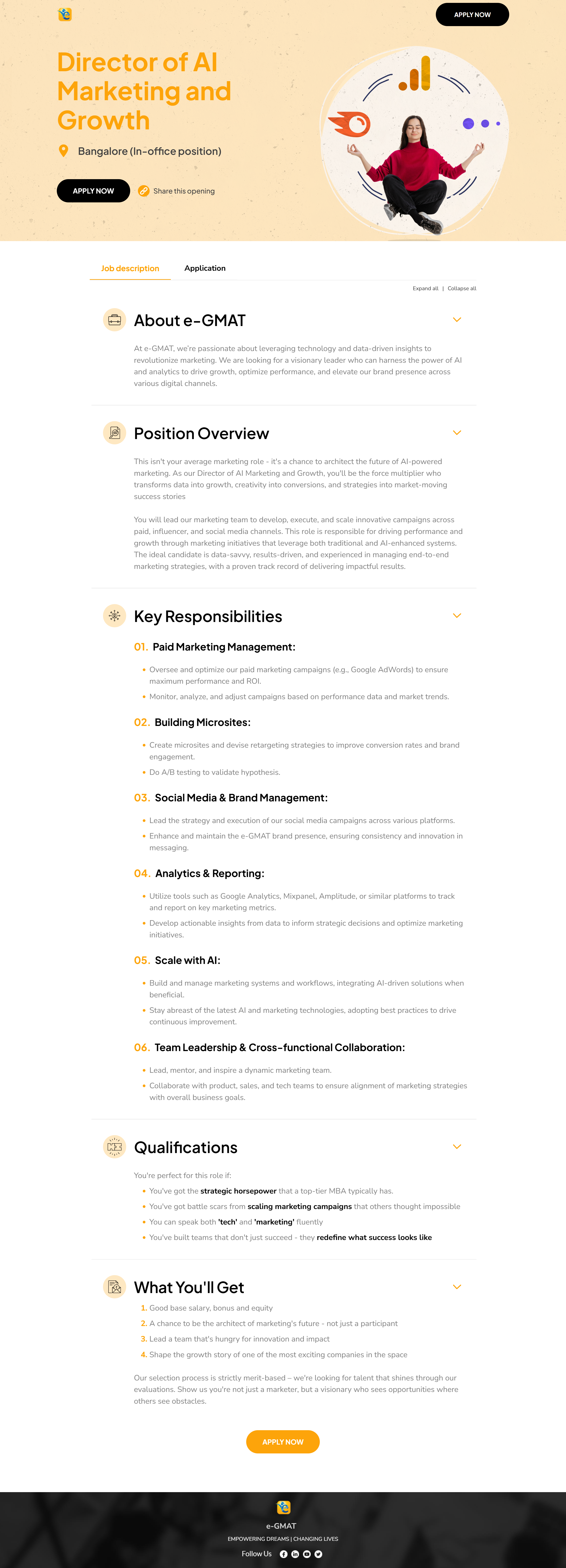
The careers pages apply the same growth thinking to a different audience: a homepage that pitches the company's mission and culture with the same warmth as a product page, and a job-description template that keeps every opening scannable — role, responsibilities, qualifications, and "what you'll get" in a consistent, accordion-style structure a candidate can read in a minute.